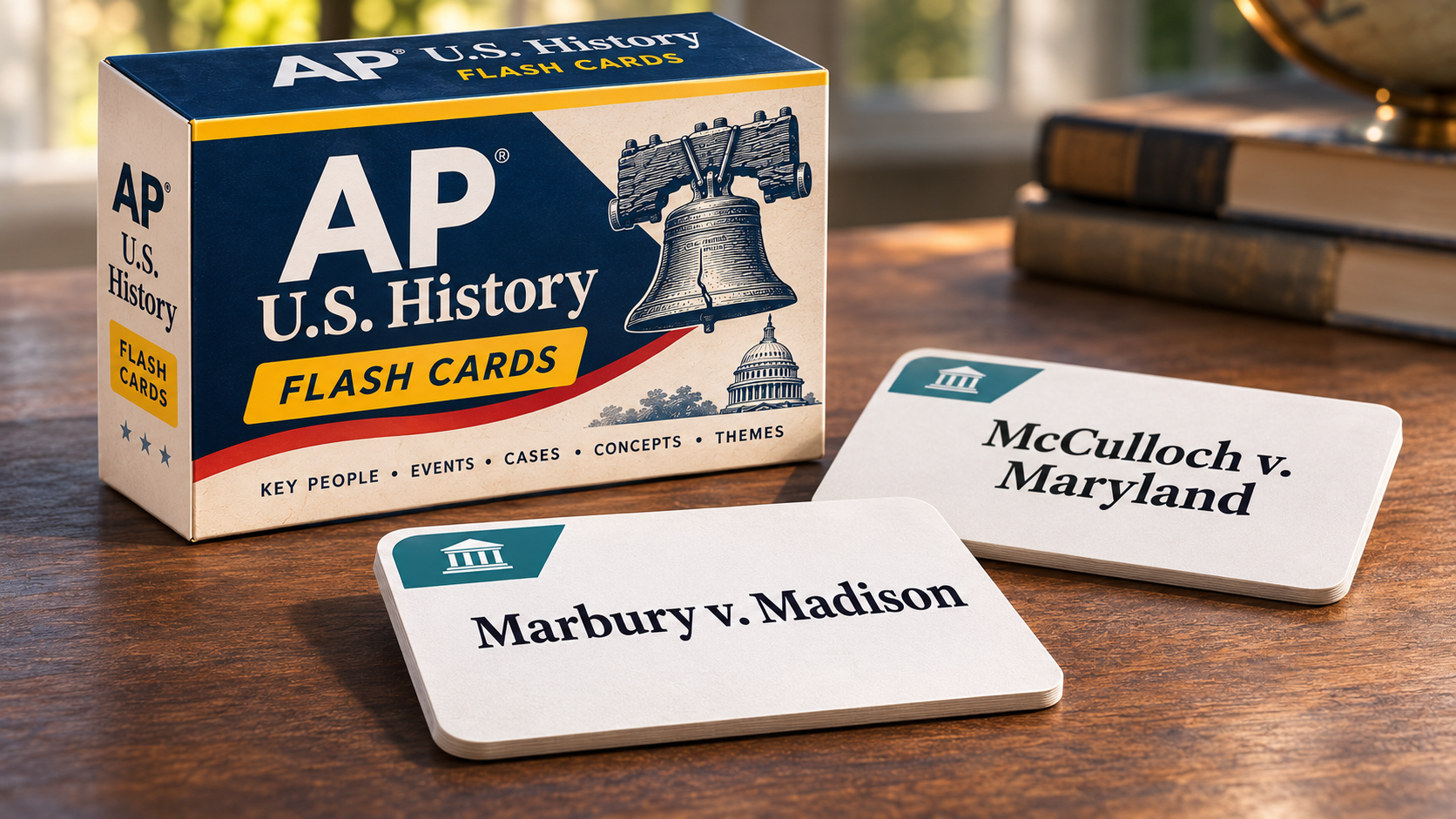
GG asked me to review two complex cases with her for her AP US History (APUSH) class: Marbury v. Madison and McCulloch v. Maryland. I said yes immediately, because I consider it a peak dad moment to help my kid study, plus I like history and assumed I'd be good at this.
I wasn't. We started with flashcards, which tell you what a case decided and not why. They didn't do enough.
So we moved to YouTube and watched Heimler's History together, and for me, something clicked. GG wasn't there yet. She was still nervous about the short essay, and knowing the cases isn't the same as explaining them on a clock. So I went looking for a metaphor that would turn two cases into one idea.
I ran examples in my head. Most fell apart. Then I landed on one that meant nothing to GG but was exactly what I needed. It didn't just clarify how these two Supreme Court cases work. It explained why the review process at my work is set up the way it is.
For most of my career I've sat in planning meetings and retrospectives where the same sentence kept coming up:
Just tell me all the details, and then I won’t have to do any rework.
That's a very understandable mindset for an engineer. Software developers will happily spend days automating a task that takes minutes if it means never doing it again. On the lean, regulated marketing team where I work, “no rework” sounds reasonable, even necessary.
This essay is about why “no rework” can't be promised, why we keep asking anyway, and what two court cases from 1803 and 1819 have to say about it.
The two cases, plainly
McCulloch v. (where I call home) Maryland first, because the logic is simpler.
Congress had chartered a national bank. Maryland, which didn't care for the bank, taxed it. The cashier of the bank's Baltimore branch, James McCulloch, declined to pay. That's how a Baltimore bank cashier ended up with his name on one of the most important cases in American history.
Maryland's argument was simple, and it may sound familiar. The Constitution lists what Congress can do, and "charter a bank" isn't on the list. Show us where it says you can.
Chief Justice Marshall's answer was that the list isn't finite. Article I, Section 8 gives Congress the power to make laws "necessary and proper" for carrying out the powers it does have, and "necessary" doesn't mean "indispensable." Congress needs good means, not the only means.
The test, in full: if the end is legitimate and within the scope of the Constitution, and the means are appropriate, plainly adapted to that end, not prohibited, and consistent with the spirit of the document, then the means are constitutional.
Notice what Marshall doesn't do. He doesn't hand Congress a blank check. He hands it a test. Is the end legitimate? Are the means appropriate? Is anything prohibited? Does it fit the spirit of the thing? Those are questions Congress can ask itself before it passes any bill.
So McCulloch gave Congress room to work. Marbury is what keeps that room from turning into a free-for-all.
Now back to 1803, where the story reads more like political theater. In his final hours in office, President Adams signed a stack of last-minute appointments, and the incoming Jefferson administration refused to deliver the ones that hadn't gone out. William Marbury's was one of them. So he sued James Madison, Jefferson's Secretary of State, and under the Judiciary Act of 1789 he took the case straight to the Supreme Court.
Chief Justice Marshall, again, starts from agreement: Marbury is right. He's entitled to the job. But being right isn't the same as being in the right court. The Judiciary Act let Marbury come straight to the Supreme Court. The Constitution does not. Article III lists the few kinds of cases the Court can hear first, and Marbury's isn't one of them. Congress had tried to hand the Court a power the Constitution doesn't grant, and when a law and the Constitution collide, the Constitution wins. So that part of the law is void.
In the process the Court declared that it is the judiciary's job to say what the law is. Read it closely and the Court turned down a power Congress tried to hand it, and in the same breath claimed a far larger one: the power to review the work and say no. Jefferson got the outcome he wanted that day, and a precedent he couldn't take back.
By the way, this synopsis would crush it on the AP US History short answer section. If you found this article because you are now studying, you should write this all down, and maybe stop here. But for the rest of us, here's how this applies to, well, just about everything, but especially regulated businesses like the one I work in.
Back to work
Here's how the cast maps in my regulated business.
My marketing team is like Congress. We have a broad grant, which is to make something that connects with people, and a great deal of implied powers about how.
But there is a check on that power: our version of the Supreme Court, an external regulator (in my case, the SEC or FINRA) who can require changes, pull the work, and levy fines as punishment for shipping something that wasn’t allowed.
That check is reactive on purpose. A decade before Marbury, in 1793, President Washington asked the justices for legal guidance on questions that hadn't become cases. The justices declined to answer. Courts don’t deal in hypotheticals; they adjudicate real things that really happened. The SEC and FINRA tend to as well.
At the Constitutional Convention, James Madison offered an alternative to after-the-fact review. He proposed the Council of Revision, a body that would review laws before they took effect. The Convention didn’t go for it, but it’s standard in our industry today: internal compliance.
So we put the council back. Its real job is to predict how the Court would rule.
There will be no rulebook
The frustration is real. When work is pulled, altered, or fined late, it's expensive and demoralizing, and everyone in the room understands why people ask for the rulebook.
I hear the same from Etsy makers whose listings get removed and YouTube creators whose videos get demonetized. Just tell us the rules and we'll follow them.
The rules they're asking for can't be written. Not because anyone is hiding them, but because the next piece of work will be one nobody anticipated. That's what creative work is. A rulebook asks the reviewers to do what the framers couldn't.
Reactive review is where the creativity lives. A rulebook can only approve what somebody already imagined. A review process can approve something nobody imagined, because it judges the thing itself. The national bank wasn't on anyone's list until it existed.
So the agency of creativity requires the accountability of reactive judgment. But that doesn’t mean it has to be exceptionally slow and expensive.
Earlier and cheaper
Courts don't decide each case from scratch. Decisions stack. Over time they form precedent, and precedent is what makes a reactive system predictable enough to work inside.
A regulated marketing team can do the same thing. Keep a running record of past decisions, with the reasoning attached, not just the verdict. Build a library of components that have already been cleared.
The design system I maintain is certainly a style guide for our team and partners, but more than that, it’s an assembly of approved approaches, a body of design precedent.
The internal review team then becomes less of an antagonist and more of a partner. You are building together a foundation that is solid and predictably allowed by the external regulators.
What a tireless council might add
This is the part I'm least sure of, so take it as a pontification, not a strategic direction.
Picture Madison’s Council of Revision not as a single step in the workflow but as a presence at every step. They are in the room, always available, always ready to weigh in either now or in five hours when your tokens reset.
Of course we’re going to talk about AI.
If the playbook is a pipe dream and creative work needs to be counterbalanced by reactive judgment, the way to optimize is to build that feedback loop into the process itself. At every step: the sketch, the headline, the first pass of copy. It flags risk while the work is still cheap to change, explains why, and tells you how your human internal reviewers and external regulators are likely to interpret it.
Disclaimers would surely abound. This would be clearly defined as an advisory tool. The final call belongs to the professional internal review team, who are accountable for providing a reliable preview of the external regulators.
Even in an advisory capacity, a tool like this at each step of a regulated process can turn a late-stage "no" into an early "go fix it," when the cost is an afternoon of rework instead of a canceled campaign’s projected revenue.
But AI is dangerous
Yes, for many reasons, but one of the less world-ending ones is that having such an AI tool in the process can change the incentives for the creative team.
There's a trap worth watching for. If designers start making things to please the predictor, we've stopped designing for the user and started down yet another route to the elusive rulebook, this time packaged with flattery in a cute bot.
The best version of such a tool would surface questions to challenge the thinking of the creative team rather than issuing verdicts.
The pull toward "tell me up front" is going to get stronger once there's a tool with delightful manners that seems to know the answers. That's the moment to remember what Chief Justice Marshall did.
He didn't answer the question in advance. He gave people a test, and a court to appeal to.
Back to GG
As all this was swirling through my head, forming into a well-organized breakdown of the fascinating parallels between the founders' checks and balances and my day-to-day engagement with our compliance team, GG let me know she had figured it out and was all set.
I never did give her the metaphor. She didn't need it. The metaphor, it turns out, was for me.
Which is just as well. Sometimes the best way to be a peak-level dad is to make yourself available while they figure it out on their own.