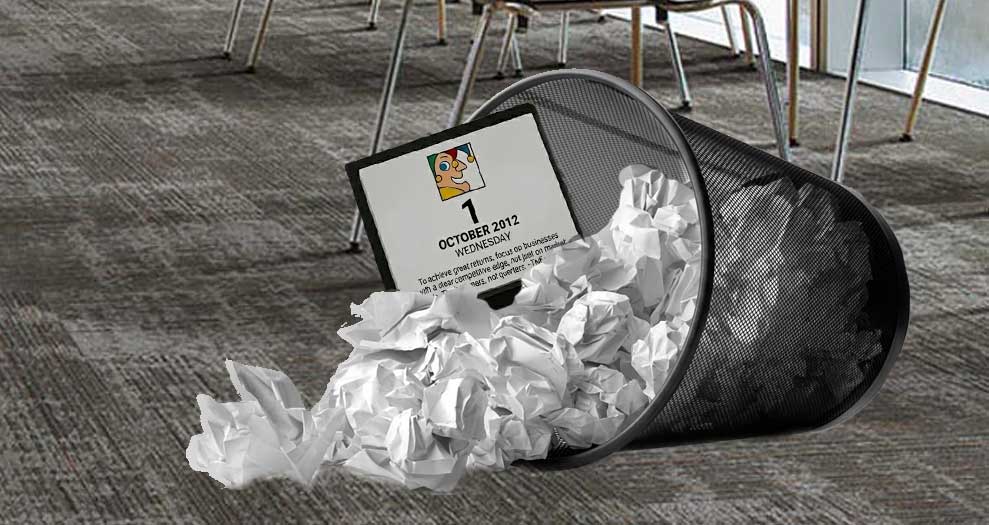
We had already generated a few hundred statements about our company culture when I suggested we turn them into a desk calendar. Not just for our cohort. For every employee.
This was part of a leadership training program — a small group of "up and coming" leaders asked to define what our culture actually meant in practice. We brainstormed. We debated. We refined. The list grew quickly, the way lists do when the room has momentum and the stakes feel vaguely important.
Somewhere north of 200 ideas, I decided we should get to 365. One for every day of the year. It felt symbolic. Complete. Ambitious. The kind of thing that looks good in a slideshow and even better when you can hold it in your hands. And, if I'm honest, it felt like proof.
There's a particular kind of ambition that shows up when you feel like the weakest person in the room. It doesn't say, help me learn. It says, watch me deliver. Completion is an easy thing to confuse with value.
Momentum Isn't Strategy
The idea caught quickly. I volunteered to drive it. I became the person who kept the thread alive, tracked the gaps, chased missing submissions, and pushed the group to fill the last stretch to 365.
When I brought it to the head of HR and Culture — the person running the session — he hesitated. He said something simple, and in retrospect, painfully accurate: no one uses desk calendars anymore. This kind of thing was a relic. It wouldn't land. He wasn't dismissing the intent. He was pointing at behavior. He was trying to save us from building something that would be instantly ignored.
I treated that feedback like a speed bump, not a signal.
One of the subtle ways insecurity shows up is that it makes experienced input sound like resistance. Anything that slows the project starts to feel like something to overcome. I countered. I reframed. I pitched it as reinforcement, visibility, culture made tangible. I pushed.
Eventually, he approved the budget. Looking back, "approved" is generous. He went along with it. Those are not the same thing, and the difference matters.
The Launch That Didn't Stick
We handed the calendars out desk-to-desk like a surprise gift. It was meant to be fun — a bright little artifact of shared values. Something you'd glance at, smile at, and carry with you into the day.
Some people were genuinely delighted. Some were politely confused. A lot of reactions landed in the gray zone of "thanks… what is this?" No one had asked for it. That's not always fatal — sometimes you ship something people didn't know they wanted. But it's a risk that should make you more curious, not more certain.
As the year went on, I kept an eye out. By midyear, I could find maybe three or four still on desks. His prediction wasn't cynicism. It was accuracy.
If something is supposed to shape behavior, the metric can't be "did we launch it?" It has to be closer to "did it stick?"
The Professional Cost
Not long into that new year, the head of HR and Culture asked to meet.
He said he had gone along with it because I hadn't given him much room not to. He said that wasn't the way to work. I had pushed past collaboration into coercion — not in a dramatic way, not with threats, but with sheer persistence and social pressure and momentum. The kind of pressure that makes it easier to say yes than to keep saying no.
I'd lost some professional credibility with the project. That conversation stayed with me, partly because it was fair, and partly because it revealed something I didn't want to see: you can "win" a project and still lose trust. Alignment isn't something you get by being determined. It's something you earn by listening.
The "What the Hell" Moment
The real gut punch came later.
Deep into the calendar year — long after the handout energy faded — one of the entries landed wrong. More polarizing than intended. It offended someone. When you ship a "culture" artifact at scale, you're not shipping a cute idea. You're shipping a message about what the organization endorses. Small misjudgments don't stay small.
The offended coworker stormed to my desk, calendar in hand, and said, "What the hell?" I remember the heat in my face. I remember apologizing. I remember realizing, in real time, how far the whole thing had drifted from where it started.
When I reflect on that project now, I don't picture the delight in seeing the stacks of calendars come in, or the hopefulness in the enthusiastic rollout. I'm back at my desk apologizing to a colleague. I'm back in that meeting with the boss learning a hard lesson. Those are the only parts that stuck.
What I Was Actually Doing
At the time, I would have described the project as initiative. Ownership. Going above and beyond. But the truer story is simpler.
I was in a cohort of a dozen rising leaders and I felt like the farthest behind — the least experienced, the least fluent, the least obvious "belonging" in the room. I was trying to prove I deserved to be there, mostly to myself, but through actions that were visible to everyone else.
The calendar was perfect for that. It was tangible. It was measurable. It was large. It was the kind of output that creates the illusion of impact because it can be counted. It's uncomfortable to admit, but clarifying: I wasn't really trying to build culture. I was trying to build evidence.
When the work is secretly about your standing, it stops being about the mission — even if you keep using mission-shaped words.
The Strategic Point
This is why "strategic prioritization" can't just mean picking a project and pursuing it harder. Organizations constantly confuse motion for progress — a project gathers momentum, someone champions it, it gets green-lit, and suddenly it feels important because it's moving. But strategy isn't motion. It's intention plus consequence.
The questions that would have helped me then are still the ones that matter now: Who is this for? What objective does it serve? What would success look like six months after launch? What are we not doing because we're doing this? Are we building something needed — or something visible?
I optimized for completion, for scale, for a clean "we did it" moment. I didn't optimize for adoption. A finished deliverable is not the same thing as a finished strategy.
Autonomy, Earned
One of the biggest leadership lessons hiding inside this story is about autonomy. Autonomy isn't "let people run" — it's "give people clear objectives and let them choose methods." But that only works when you pair freedom with accountability and alignment. When someone is driven more by proving themselves than by serving the objective, autonomy becomes a force multiplier for the wrong thing. The work moves faster, but in the wrong direction. The organization spends resources and trust on something that doesn't stick.
And it feels particularly relevant right now as we've handed teams the most powerful force multiplier many of us have seen in our careers: AI. The productivity gains are real, but they're not evenly distributed. The biggest lift often shows up as more output, not necessarily better outcomes.
Without clear objectives and accountability, AI doesn't fix misalignment — it accelerates it. You can ship work that looks impressive in quantity, moves quickly, and still fails the only test that matters: did it change anything? The missing ingredient in a lot of the excitement is judgment: just because we can produce something faster doesn't mean it's worth producing at all. If anything, the ease of execution makes the "relic" warnings easier to ignore — the quiet, pragmatic signals that something won't land.
Sometimes the move isn't pushing harder. It's pausing long enough to hear the warning you're tempted to dismiss.
The older I get in leadership roles, the more I think prioritization is less about choosing what to pursue and more about choosing what not to scale. Not every good idea deserves oxygen. Not every enthusiastic champion is aligned with the highest objective. Not every visible output is meaningful progress. Sometimes the right call is stopping at 50 ideas. Or 20. Or 5. And making those five matter.
When I think about that time now, the calendar itself is almost irrelevant. What matters is what it taught me. Proving you belong and serving the mission can look deceptively similar from the outside. From the inside, they feel very different. And learning to tell the difference is where strategy lives.
That head of HR and Culture who told me the truth deserves more credit than I can give him here. The colleague who came to my desk deserved better. The thoughts, opinions, regrets, and lessons learned expressed here are my own. My employer had no part in this reflection, though they did have to pay for all those calendars.